The Dakota War of 1862 Part Three: The Reckoning
This is the last of three posts on the Dakota War of 1862. The second, Six Weeks, followed the war to the Dakota surrender at Camp Release.
By the end of September 1862 the fighting was over. The Dakota who surrendered had fought a war and expected to be judged as defeated soldiers. Minnesota had something else in mind: "The Sioux Indians of Minnesota," the governor declared, "must be exterminated or driven forever beyond the borders of the State."
Vengeance
Military tribunals began immediately. Over several weeks, 392 Dakota men were tried, with the commission settling up to 40 cases in a single day with some trials lasting as little as five minutes. The first prisoner tried was Joseph Godfrey, known as Otakle, the son of a Black mother and a French-Canadian father, who had been married to a Dakota woman and had lived at the Lower Agency for five years. He was sentenced to hang. He then agreed to turn state's evidence, had his sentence commuted to 10 years, and testified in detail against a number of his former colleagues. He served three years before his release. Dakota defendants who made no such deal fared far worse.
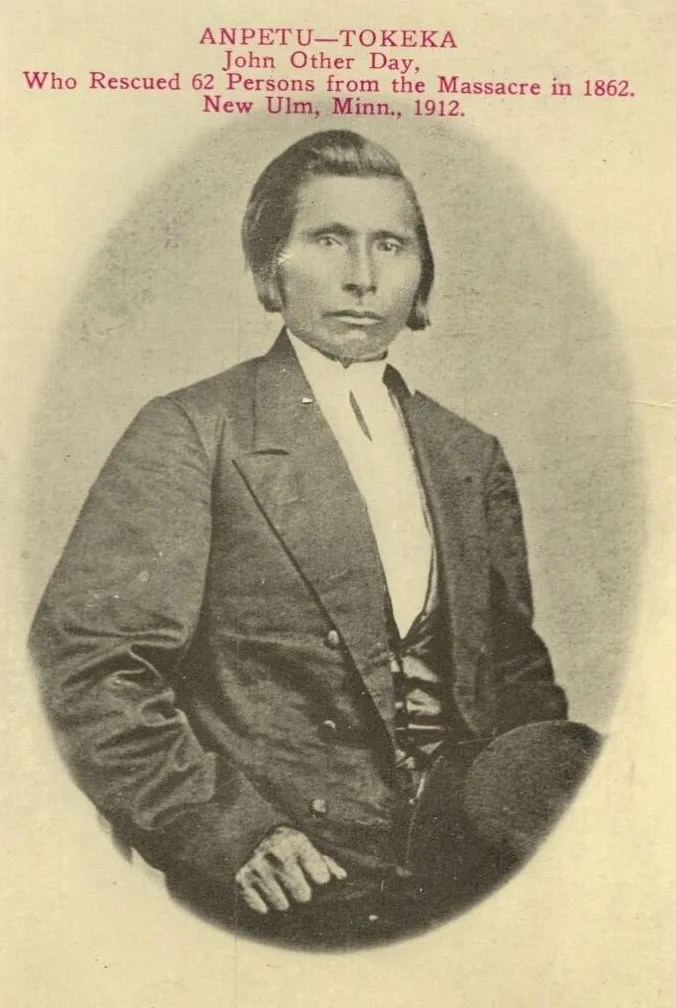
Unfamiliar with American legal proceedings and believing they had fought a legitimate war, they freely admitted to participating in battles. They answered honestly about fighting soldiers, not realizing that American law would treat these as acts of murder rather than combat. As soon as a prisoner admitted firing at whites, no matter where, the commission sentenced him to hang. By November the commission had condemned 307 men, though the list was pared to 303 before it left the state. The one name Sibley struck himself belonged to the brother of John Other Day, a Dakota who had led dozens of white settlers to safety the morning the war broke out, and the sentence was set aside for thin evidence and on Other Day's own appeal.
The question of who even had authority to carry out the executions climbed the chain of command until it reached Washington, and President Lincoln took it on himself. He ordered a stay of every execution until he had personally reviewed the trial records. The list of 303 condemned names had reached Washington by telegraph first, at a cost of $400, but Lincoln would not act on a list of names alone and had the full trial transcripts sent to him by mail. Already sick of the bloodshed from the war in the South, he had no stomach for a mass hanging, and he agreed with Commissioner of Indian Affairs William Dole that it would be "a stain on the national character." A recent meeting with Episcopal Bishop Henry Whipple weighed on him too. Whipple had laid out the decades of fraud and abuse that drove the Dakota to war, and Lincoln was moved enough to pledge, "If we get through this war, and I live, this Indian system shall be reformed."
Minnesota wanted all of them dead. The press howled for it, one paper screaming "DEATH TO THE BARBARIANS!" and the Mankato Weekly Record warning that the condemned would die "either by order of the President, or by the will of the people, who make Presidents." General John Pope, sent west to put the uprising down, had already announced that he meant to "utterly exterminate the Sioux" and to treat them "as maniacs or wild beasts," not as a people any treaty could bind. He flooded Washington with lurid accounts of children nailed alive to trees and women cut open, most of it with only the thinnest basis in fact, and the stories did their work on the public mood. He and Governor Ramsey pressed Lincoln with the same warning, that if the prisoners were spared the mob would butcher them anyway.
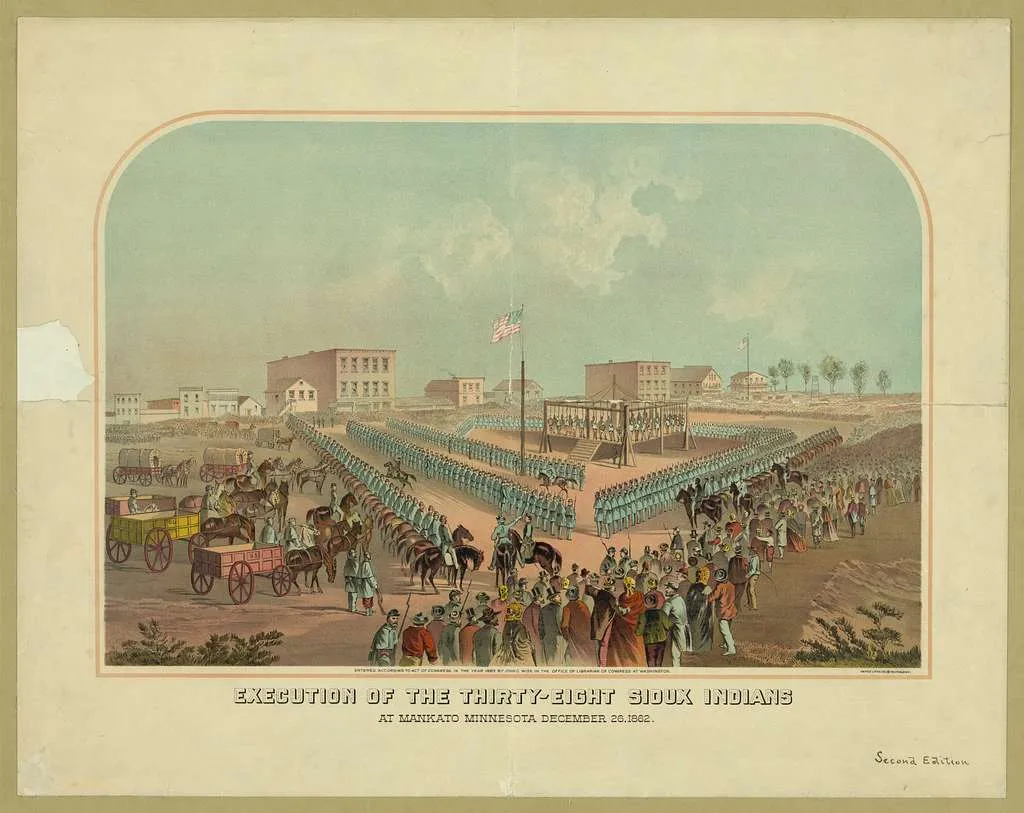
The President gave Minnesota neither the wholesale execution it demanded nor the release of the prisoners. Instead, he had two clerks comb the trial records to separate the men convicted of raping or murdering civilians from those who had only fought in the battles, and he wrote out the final names himself. On December 8 he approved death sentences for 39 of the 303 men whose cases had been sent to him, and one of those was reprieved before the day came. Lincoln had first set the hanging for December 19, then let it slip to the day after Christmas. Through Christmas Eve the condemned could hear hammers ringing as the great square gallows went up, and many spent their last night visiting relatives and holding a calm face, saying they expected to go straight to the Great Spirit. On December 26, 1862, at Mankato, Minnesota, the remaining 38 were hanged simultaneously from a single scaffold. It remains the largest mass execution in United States history.
Exile
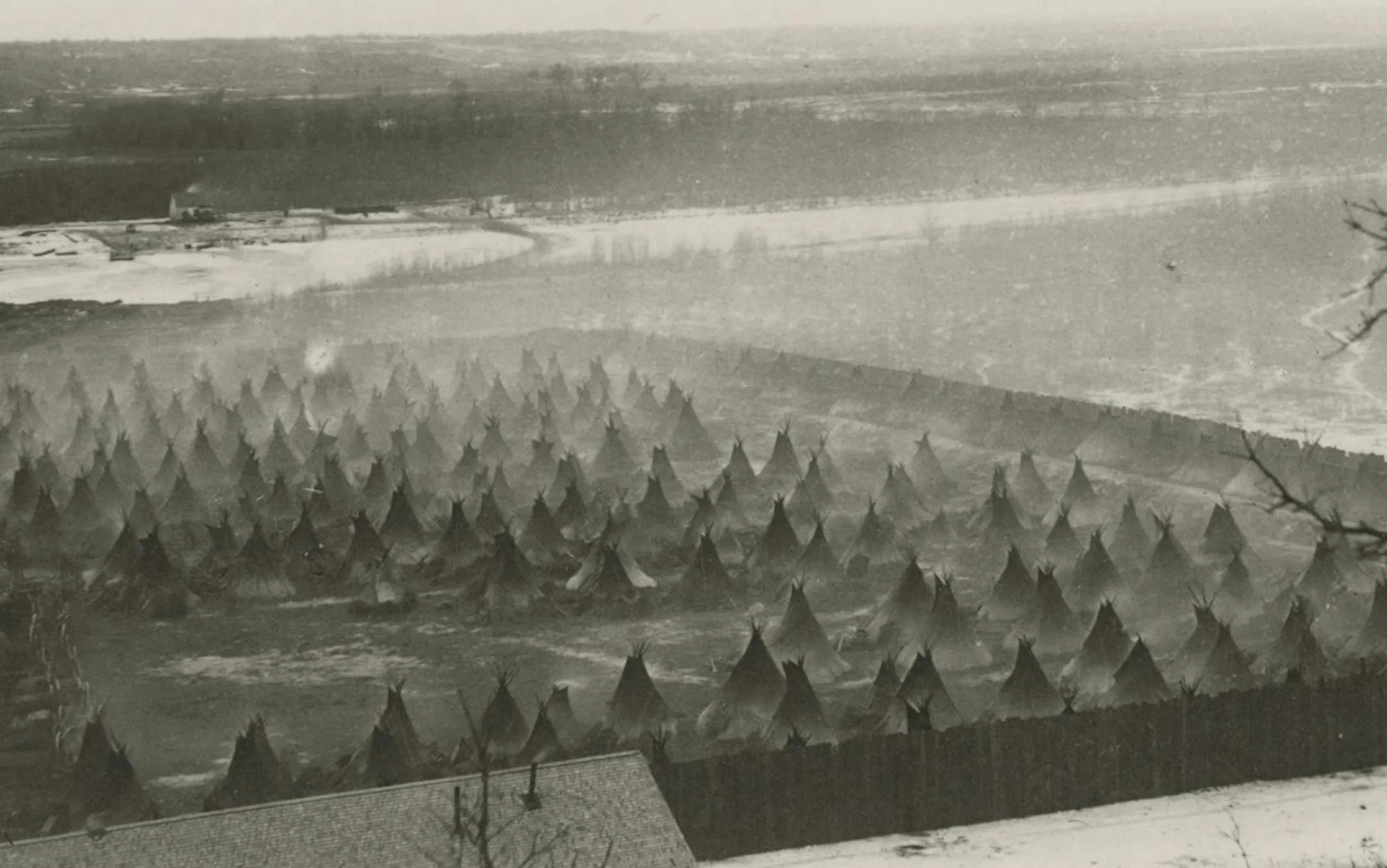
The punishment had only begun at the gallows. In November the army marched more than 1,700 Dakota, most of them women, children, and old men who had taken no part in the fighting, 150 miles east toward Fort Snelling. The column of wagons ran four miles long, guarded by a few hundred soldiers who feared the settlers along the road more than they feared the prisoners. At Henderson a mob swarmed the wagons, throwing rocks and scalding water, and one woman snatched a nursing infant from its mother's arms and dashed it to the ground, killing it. The survivors reached Fort Snelling and were crowded into an enclosure too small for their numbers, without adequate shelter or sanitation, and held there through the winter. Measles spread through the camp. Then dysentery. Hundreds died of disease and exposure before spring. The roughly 300 men convicted by the commission but spared the gallows were sent by boat to a prison at Davenport, Iowa. When the ice melted, the 1,300 survivors at Fort Snelling were loaded onto steamboats and forced out of Minnesota. Crowds gathered along the riverbank to jeer and curse as the people were carried away from their own land. Ramsey had already said exactly what the state intended, and now it was being carried out.
The boats carried them to Crow Creek, on the Missouri River in Dakota Territory. The cattle driven overland to feed them arrived emaciated from the 300-mile journey. The flour and pork that came with them were condemned as unfit even for soldiers. What food existed was cooked in vats and ladled out to the women. Many refused it. The first winter at Crow Creek killed hundreds more.
In February 1863, Congress passed an act declaring that "all treaties heretofore made and entered into by the Sisseton, Wahpaton, Medawakanton, and Wahpakoota bands of Sioux or Dakota Indians... are hereby declared to be abrogated and annulled." Every obligation was unilaterally voided. The annuity payments owed under those treaties were redirected to a fund to compensate the white settlers harmed by the war, though Congress also, perhaps in some minor recognition of their part in the conflict, set aside unspecified land for the Dakota beyond Minnesota's borders. Their homelands were opened fully to white settlement.
The prisoners at Davenport, Iowa were held for three years. Disease and confinement took many of them. A smaller group was pardoned in 1864, and in April 1866 President Andrew Johnson pardoned the 247 who remained, finally allowing them to rejoin their families, by then living on the Santee Reservation in Nebraska.
Little Crow did not stop fighting after Wood Lake. He fled west and spent the winter trying to build a wider alliance to carry the war on, but the Yanktons turned him down and the Sisseton and Wahpeton bands blamed his Mdewakanton for a war that had ruined them all. In the spring he led about 200 warriors up to the Mandan and Gros Ventre villages near Fort Berthold on the upper Missouri, hoping to bring them in. His men came in holding the peace pipe aloft, dancing and whooping and firing their guns into the air, and the villagers met them with gunfire. Most were cut down. Among the dead was Little Dog, the same man who had ridden ahead to warn Major Brown's family the morning the war began. The disaster broke whatever hope Little Crow had left. He crossed into Canada, then drifted back into Minnesota that summer with his teenage son.
He had said once that if a white man ever laid hands on him, it would be after he was dead. By the summer of 1863 Minnesota was paying a bounty for Dakota scalps, and any Indian glimpsed on the settled frontier touched off panic and pursuit. On July 3, 1863, Little Crow was picking raspberries with his son in a thicket near Hutchinson when two settlers shot him. The men had no idea who he was. After the body was identified the state paid the bounty for it, and his scalp and skull were put on display as war trophies at the Minnesota Historical Society, where they stayed for more than a century before they were returned to his descendants for burial in 1971. His warning speech outlived him, carried out of that council in his son Wowinape's memory and written down years after the war.
What Remains
Big Eagle, who had argued for restraint at the midnight council, lived through all of it. He was imprisoned at Davenport, pardoned, and made his way back to the Minnesota River valley, settling near the old Upper Agency at Granite Falls. He died there in 1906, 44 years after the state had declared that his people would be exterminated or driven out forever.
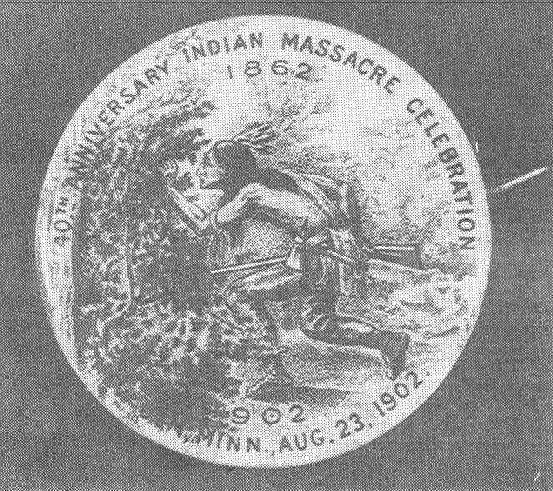
The town of New Ulm held several celebrations of anniversary of the war, most notably the 40th and 50th anniversaries in 1902 and 1912, respectively, with decorations and a parade, and reunions of settlers and soldiers who had been there.
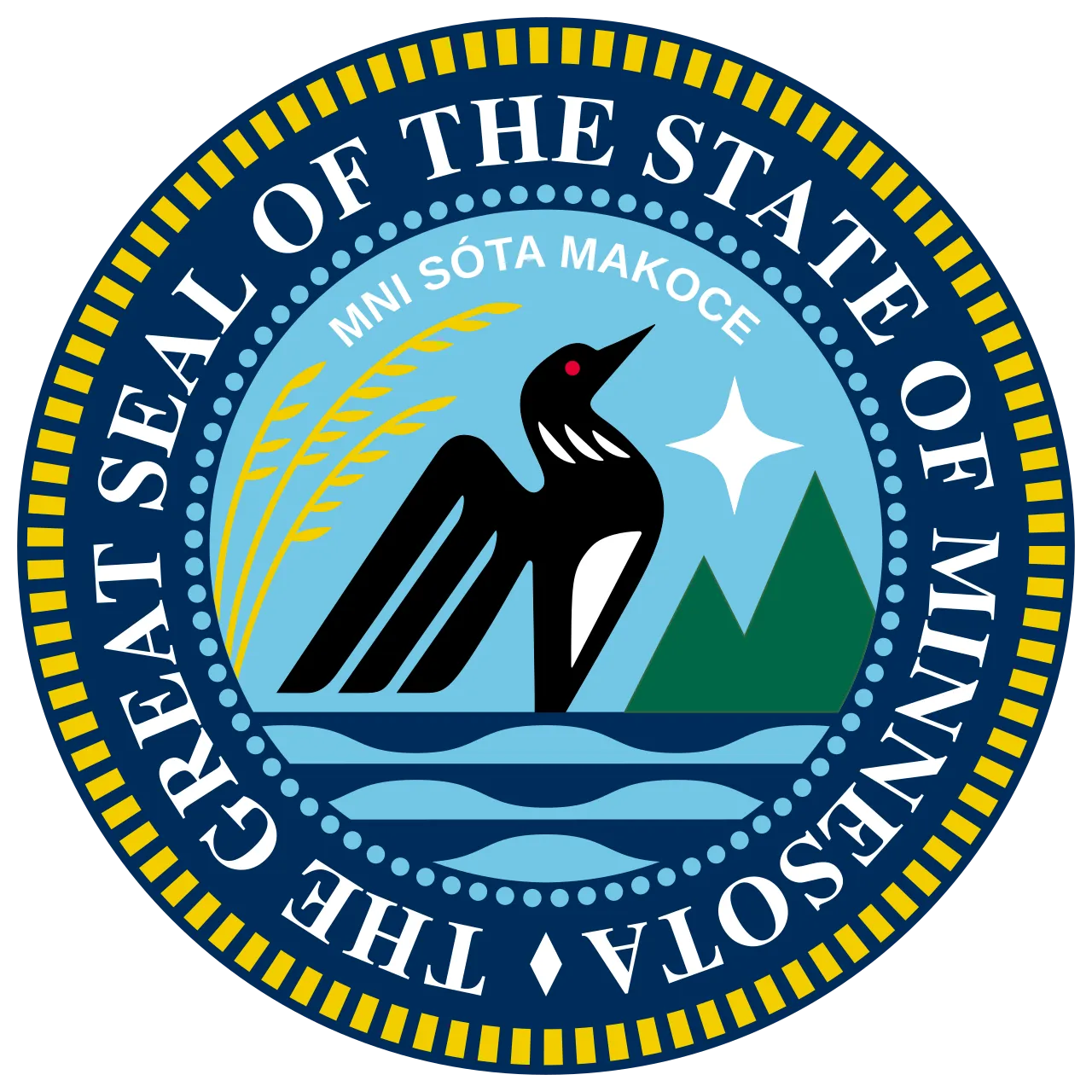
Bdote, where the Minnesota meets the Mississippi, is the center of the Dakota world. Their creation stories say the first people came up out of the earth and water there. Fort Snelling stands on the bluff above it, and the camp where 1,700 Dakota were penned through the winter of 1862 sat on the flat just below, which means the army held them to die at the place their stories say they were born. The state that grew up over that ground kept their word for it. Mni Sóta Makoce, the land where the waters reflect the sky, became Minnesota.
Small tracts have been returned in recent decades, the language is being taught again, and memorials stand where the agencies and the gallows once were. But most of us who grew up here learned the name but never the cost behind it. Little Crow saw exactly how the war would end and chose to walk into it beside his people. The Minnesota I live in was built on the ground they lost, and we were never taught how.
References
- Anderson, Gary Clayton, and Alan R. Woolworth, eds. Through Dakota Eyes: Narrative Accounts of the Minnesota Indian War of 1862. St. Paul: Minnesota Historical Society Press, 1988.
- Carley, Kenneth. The Dakota War of 1862. 2nd ed. St. Paul: Minnesota Historical Society Press, 2001.
- Flanagan, John T. "Thoreau in Minnesota." Minnesota History 16, no. 1 (1935): 35–46.
- Harding, Walter. "Thoreau and Mann on the Minnesota River, June, 1861." Minnesota History 37, no. 6 (1961): 225–28.
- Michno, Gregory. Dakota Dawn: The Decisive First Week of the Sioux Uprising, August 1862. El Dorado Hills, CA: Savas Beatie, 2011.
- Minnesota Historical Society. "U.S.-Dakota War of 1862: Timeline." https://www.mnhs.org/usdakotawar/timeline.
- Wakefield, Sarah F. Six Weeks in the Sioux Tepees: A Narrative of Indian Captivity. Norman: University of Oklahoma Press, 1997.
- Waziyatawin. "Maka Cokaya Kin (The Center of the Earth): From the Clay We Rise." Paper presented at the University of Hawaii Manoa International Symposium, 2008.
- Westerman, Gwen, and Bruce M. White. Mni Sota Makoce: The Land of the Dakota. St. Paul: Minnesota Historical Society Press, 2012.
- Wingerd, Mary Lethert. North Country: The Making of Minnesota. Minneapolis: University of Minnesota Press, 2010.