The Dakota War of 1862 Part Two: Six Weeks
This is the second of three posts on the Dakota War of 1862. The first, When Patience Ran Out, traced how a decade of broken treaties and starvation brought the Dakota to the morning the war began.
Little Crow had warned his people that war with the United States would destroy them. When they chose it anyway, he chose to lead them, unwilling to let them go without him. The fighting began at dawn on August 18, 1862, and over the next six weeks the Minnesota River valley became a killing ground, leaving the Dakota who surrendered at the end to the mercy of a state that wanted them gone.
Dakota warriors attacked the Lower Sioux Agency that morning, killing traders and employees and setting buildings ablaze. Smoke rose over the Minnesota River valley as word spread to isolated farms. Hundreds of settlers fled toward Fort Ridgely and New Ulm, some making it, others caught on the roads. The warriors looted and burned the farms the families left behind, though a federal commission later found that not all the ruin was theirs, that white looters had crept in afterward and "completed what the ... savage had spared." The annuity money, still in its wagon from the overnight journey, was hidden in a building at the fort and eventually returned to Saint Paul.
The fighting was never confined to the river valley. In the opening days, war parties struck isolated settlements across the frontier. At Beaver Creek, a party killed nearly everyone, sparing the settler Helen Tarble, who had learned the Dakota language and earned their goodwill. Over the following weeks there were attacks at Lake Shetek and West Lake on August 20, twin assaults on Fort Abercrombie out in Dakota Territory on September 3 and 6, and raids on the stockaded towns of Forest City and Hutchinson on September 4.
(The fear outran the war itself. As late as the summer of 1863, when the war was well over, an unsubstantiated rumor of Dakota hiding in the Big Woods would empty Wright and McLeod counties, with panicking families streaming toward Saint Paul with whatever they could load.)
Among the early casualties of the uprising was Andrew Myrick, the trader who had told starving Dakota to eat grass. His body was found with a mouth stuffed with grass.
That same day, Captain John Marsh led 46 soldiers from Fort Ridgely to the Redwood Ferry crossing, just across the Minnesota River from the Lower Sioux Agency, responding to reports of an attack. It was a trap. Marsh was killed along with half his men before survivors could retreat. The fort's garrison had been cut before the siege even began.
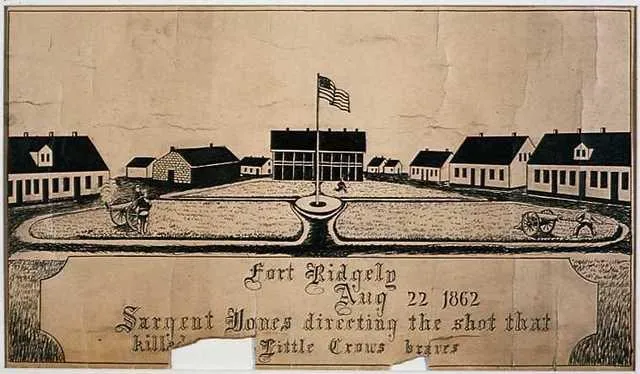
Fort Ridgely had no stockade. It was a collection of detached, unfortified buildings grouped around a parade ground, with ammunition magazines 200 yards away on the open prairie. The Dakota attacked it on August 20 and returned on August 22, both times hitting hard enough that if they had pressed their attack further, before refugee settlers crowded inside the walls, the fort almost certainly would have fallen and opened a clear route east to the Mississippi. But the warriors celebrated their victories, and the opportunity passed and did not come again.
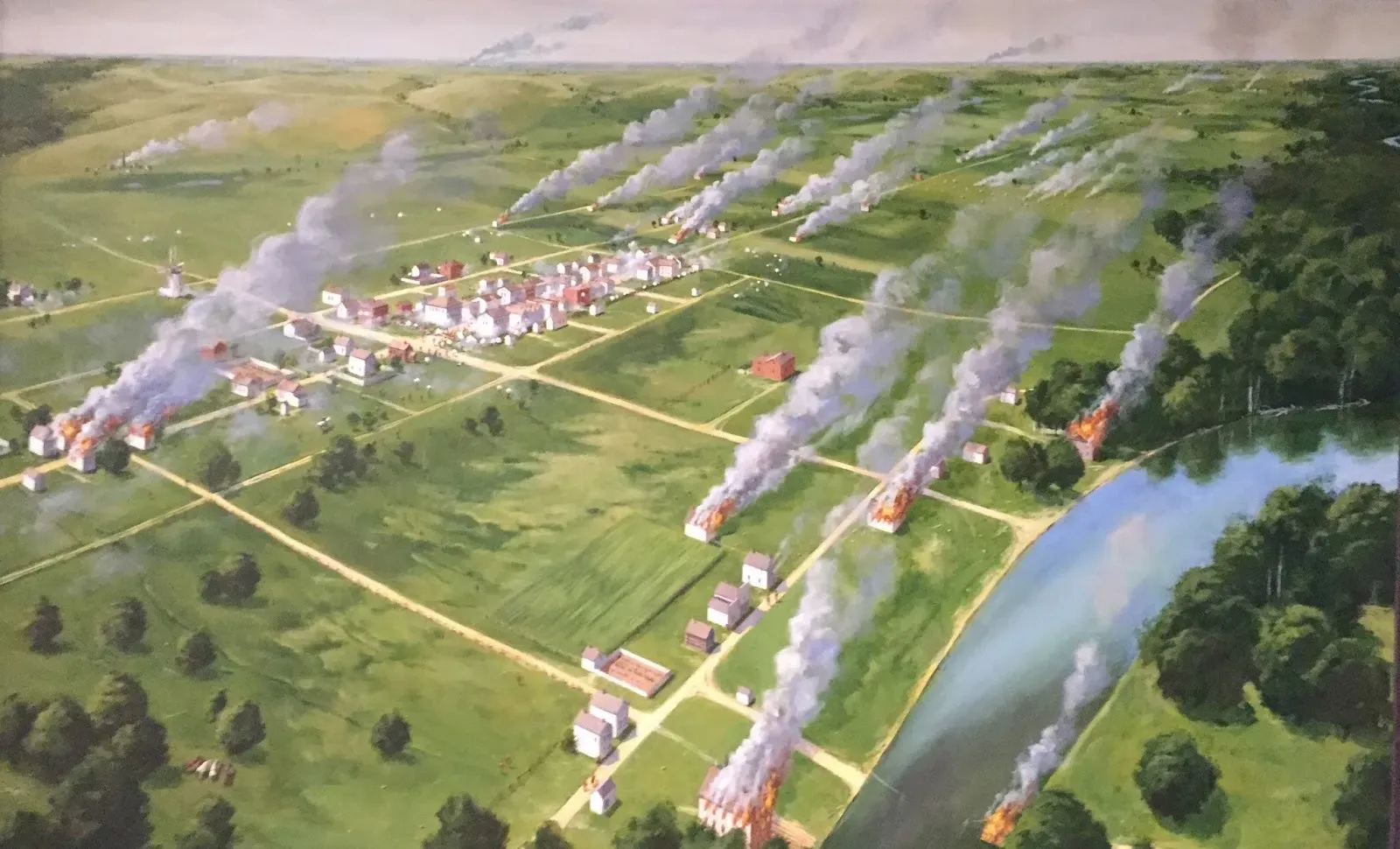
New Ulm was attacked twice, on August 19 and again more heavily on August 23. Among the defenders who died in the second battle was William Dodd, the man who a decade earlier had cut the original overland road from Mendota to St. Peter (the road that still runs through the ironically named Dakota County and further Southwest today). Dodd had been there at the Traverse des Sioux treaty in 1851, and the road he cut afterward sped thousands of settlers onto the land the Dakota had just signed away. He died defending one of the towns that road had built. New Ulm held out both times, but the second battle left more than 30 defenders dead and a third of the buildings burned. On August 25, with food and ammunition running short and another assault expected, the roughly 2,000 people sheltering in the town abandoned New Ulm and fell back to Mankato. They began drifting home in early September, and the town formally reorganized that December.
For all the early victories, Little Crow could see what most of his warriors could not. He was the war's public face, but he had never commanded its strategy, and the young men of the soldiers' lodge who had pushed for the fighting listened to him only when it suited them. Dakota warfare had always been a matter of swift raids rather than sustained sieges, and after a victory the warriors drifted back to their camps to feast and dance instead of pressing the advantage. Little Crow knew they faced an enemy that would not stop at token revenge. He begged them to spare women and children and to "make war after the manner of white men," since only a negotiated settlement could save them, and they ignored him. Privately he was bleaker still. "I can't do as I would," he admitted. "I wish to make peace. But the young men have been wronged so often and so badly, that they feel as though the choice was between being shot, or being starved to death, and they prefer the first as most honorable."
On August 20, Governor Ramsey, the same man who had ridden up the Minnesota River aboard the Frank Steele the summer before to watch the last peaceful annuity payment, commissioned Henry Sibley a colonel and gave him command of the military response. Sibley had been the state's first governor and a longtime fur trader with close personal ties to the Dakota, the kind of standing and local knowledge Ramsey wanted at the head of the expedition. He reached Fort Ridgely on August 28 with about 1,400 men. A few days later he sent out a burial party to recover the dead still lying around the Lower Agency, but Sibley himself stayed at the fort. The detail camped on open prairie near Birch Coulee, and at dawn on September 2 roughly 200 Dakota warriors under Gray Bird, Mankato, Red Legs, and Big Eagle surrounded it. The soldiers held out for about 36 hours, taking cover behind their own dead horses. When Sibley's relief column finally reached them with artillery on September 3, 13 soldiers were dead, dozens more wounded, and 90 horses lay killed in the camp. It was the costliest single fight of the war for the US.
Even with the siege broken, Sibley would not advance. He pulled his relief column back to Fort Ridgely and held there, drilling raw recruits and waiting for reinforcements and supplies. The day after he got back, already stung by the criticism, he wrote to his wife, "I see ... that the people are dissatisfied with my slow advance." The newspapers were less gentle. The St. Cloud editor Jane Grey Swisshelm took to calling him "the State undertaker, with his company of grave-diggers," and a Brown County sheriff branded him a coward and a rascal. Half his mounted volunteers deserted in disgust, and some critics accused him of secretly shielding the very people he had been sent to fight. He sat at the fort for more than two weeks while white captives remained in Dakota hands. Only when fresh regiments reached him in mid-September did he finally push his column up the Minnesota River toward the Upper Agency. On the night of September 22 the soldiers camped beside Lone Tree Lake, which they misremembered as Wood Lake and so misnamed the battle that came the next morning. Little Crow had set an ambush along the road. It sprang too early, when foraging men from the Third Minnesota stumbled into the hidden warriors, and the fight turned on Sibley's artillery. A cannon shot killed Mankato, who had led warriors at Birch Coulee three weeks before. The Battle of Wood Lake on September 23 broke the Dakota's ability to go on fighting. Three days later, at a place called Camp Release, Sibley found over 260 captive settlers still alive. Some Dakota had protected white captives throughout the war at significant risk to themselves, shielding them from warriors who wanted them killed. Little Crow had already fled west with a band of followers. Sibley had let it be known, through mixed-blood emissaries, that he meant to punish only the men who had killed settlers and to treat the rest as prisoners of war. Trusting that, and worn down, the warriors who remained surrendered and hoped for mercy.
They would not receive it.
References
- Anderson, Gary Clayton, and Alan R. Woolworth, eds. Through Dakota Eyes: Narrative Accounts of the Minnesota Indian War of 1862. St. Paul: Minnesota Historical Society Press, 1988.
- Carley, Kenneth. The Dakota War of 1862. 2nd ed. St. Paul: Minnesota Historical Society Press, 2001.
- Flanagan, John T. "Thoreau in Minnesota." Minnesota History 16, no. 1 (1935): 35–46.
- Harding, Walter. "Thoreau and Mann on the Minnesota River, June, 1861." Minnesota History 37, no. 6 (1961): 225–28.
- Michno, Gregory. Dakota Dawn: The Decisive First Week of the Sioux Uprising, August 1862. El Dorado Hills, CA: Savas Beatie, 2011.
- Minnesota Historical Society. "U.S.-Dakota War of 1862: Timeline." https://www.mnhs.org/usdakotawar/timeline.
- Wakefield, Sarah F. Six Weeks in the Sioux Tepees: A Narrative of Indian Captivity. Norman: University of Oklahoma Press, 1997.
- Waziyatawin. "Maka Cokaya Kin (The Center of the Earth): From the Clay We Rise." Paper presented at the University of Hawaii Manoa International Symposium, 2008.
- Westerman, Gwen, and Bruce M. White. Mni Sota Makoce: The Land of the Dakota. St. Paul: Minnesota Historical Society Press, 2012.
- Wingerd, Mary Lethert. North Country: The Making of Minnesota. Minneapolis: University of Minnesota Press, 2010.